



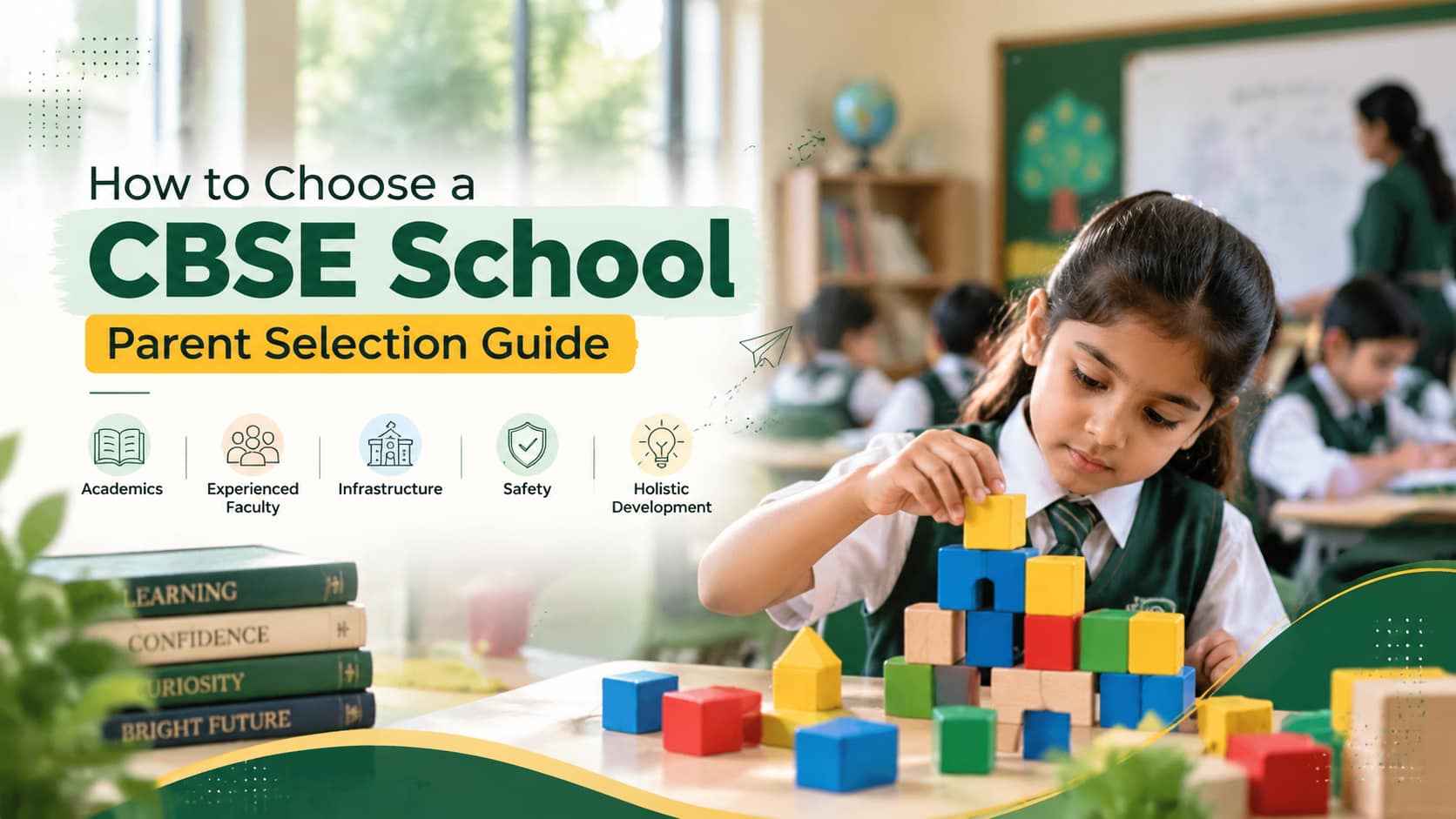
How to Choose a CBSE School: Parent Selection Guide
DPS Gaya Team
Verified Author
Choosing a school is one of the biggest decisions you will make for your child. The school you pick will shape how your child learns, makes friends, handles pressure and grows as a person for more than a decade.
Most parents start with the same few questions. Which board is right? Which school is close to home? What are other parents saying? These questions matter, but they are only part of the picture.
This CBSE school selection guide for parents explains how to choose a CBSE school step by step. You will learn what to check, what to ask on a campus visit and which warning signs to watch for. By the end, you will have a simple checklist you can use for every school on your shortlist.
Key Takeaways • Confirm CBSE affiliation first by checking the affiliation number and the school's mandatory disclosure. • Judge teachers and teaching methods, not just board exam toppers. • Visit the campus in person to see safety, cleanliness and the learning environment for yourself. • A good school balances academics with sports, arts and life skills. • Compare fees, transport and timings early so there are no surprises later. • The right school is the one that fits your child, not the one with the loudest ranking. |
What Is the Best Way to Choose a CBSE School?
The best way to choose a CBSE school is to compare a few shortlisted schools on six things: verified CBSE affiliation, teacher quality, student safety, infrastructure, all-round development and how well the school fits your child and your family routine. Then visit each school and check that what you see matches what the school claims.
A simple five-step process works well for most families:
1. Shortlist three to five schools within a practical travel distance.
2. Read each school's website and mandatory public disclosure.
3. Visit the campus on a working day, not only on an open day.
4. Talk to teachers and, if possible, parents of current students.
5. Compare your notes using the checklist later in this guide.
Why Choose the CBSE Board for Your Child?
Before comparing schools, it helps to understand the CBSE curriculum benefits. The Central Board of Secondary Education (CBSE) is a national board, and its schools follow a common framework across India and abroad.
Key Benefits of the CBSE Curriculum
• One syllabus across the country: useful for families who may move cities for work.
• Strong link with national entrance exams: the syllabus is built on NCERT textbooks, which also form the base for exams like JEE and NEET.
• Focus on concepts and skills: in line with the National Education Policy (NEP) 2020, CBSE is moving towards competency-based learning, where students apply ideas instead of memorising them.
• Clear checkpoints: regular school assessments and board exams in Class 10 and Class 12 help you track progress.
Knowing this helps you ask sharper questions. Every CBSE school follows the same board, but not every school delivers it equally well in the classroom.
Factors to Consider Before Choosing a School
The key factors to consider before choosing a school are affiliation, teachers, teaching methods, safety, infrastructure, activities, results, fees and location. Here is what to look for in each.
1. Is the School Genuinely CBSE Affiliated?
Every CBSE school has a unique affiliation number. You can verify it on CBSE's official affiliation portal (SARAS). CBSE also requires schools to publish a mandatory public disclosure on their website, covering affiliation status, staff details, infrastructure and fees.
As an example of what this looks like, you can view the mandatory disclosure published by DPS Gaya. If a school cannot show these details clearly, treat that as a warning sign.
2. Are the Teachers Qualified and Well Trained?
Teachers matter more than buildings. Qualified teachers and faculty make lessons clear, notice when a child is struggling and build confidence over time. Ask the school:
• Are teachers qualified for the subjects and classes they teach?
• How many students are in each section?
• How often do teachers attend training or workshops?
• Do teachers tend to stay at the school for several years?
CBSE expects teachers to keep upgrading their skills every year. A school that runs a structured teacher training programme shows it takes classroom quality seriously.
3. Does the School Use Modern Teaching Methods?
Look for classrooms where children discuss, question and try things out, not just copy notes from the board. Modern teaching methods usually include:
• Activity-based and experiential learning in the early years
• Projects, presentations and group work
• Regular practical work in science and computer labs
• Technology used with purpose, not just for show
Ask the school to explain how its curriculum is planned across different stages, from the early years to senior classes. A clear answer shows a thought-through approach.
4. How Does the School Keep Children Safe?
Student safety and security should never be a compromise. Use this quick safety checklist on your visit:
• CCTV coverage at entry points, corridors and common areas
• Controlled entry with visitor logs and ID cards
• Trained, supervised staff for younger children
• A medical room or sick bay with basic first aid
• Fire safety equipment and clearly marked exits
• Written child protection and anti-bullying policies
• Safe school buses with trained drivers, attendants and tracking
Read about a school's security and safety measures online, then confirm them in person. Do not hesitate to ask how the school handles emergencies.
5. Are the Infrastructure and Facilities Right for Learning?
Good school infrastructure and facilities support a healthy learning environment for children. Check for bright, airy classrooms, science and computer labs, a well-stocked library, play areas, clean toilets and safe drinking water.
Take a proper walk around the school campus instead of relying on photos. Then ask one important question: how often do students actually use these facilities in a normal week?
6. Is There Enough Focus on Holistic Development?
Marks are important, but they are not everything. Extracurricular activities in schools, such as sports, music, dance, art, debate and robotics, build teamwork, discipline and confidence. This is what holistic development of students really means.
Ask how many periods each week go to sports and co-curricular activities. Look at the range of sports offered and whether every child gets a chance to take part, not just the school team.
7. What Do the Academic Results Really Show?
Academic performance and results tell you a lot, but read them carefully. A few toppers on a banner do not show how the whole class performs. Ask about:
• Average board results, not only the highest scores
• Extra support for students who find a subject difficult
• How the school helps children manage exam stress
8. Do Fees, Location and Timings Work for Your Family?
Ask for the full fee structure in writing, including transport, uniform, books and activity charges. Check the daily travel time, as a long commute can tire young children. Make sure school timings fit your family routine.
How to Select the Right School for Your Child's Needs
Knowing how to select the right school for your child means looking at your child, not just the school. Every child is different, so think about:
• Learning style: does your child learn best by doing, reading or discussing?
• Interests: does the school offer activities your child already enjoys?
• Personality: a shy child may need a more nurturing, smaller-group setting.
• Support needs: ask how the school supports children who need extra help.
If your child is older, take them along on the visit and ask how they felt. Their comfort matters.
Things to Check Before School Admission: A 10-Point Parent Checklist
Use this list of things to check before school admission for every school on your shortlist:
☐ CBSE affiliation number verified
☐ Mandatory public disclosure reviewed
☐ Teacher qualifications and section size discussed
☐ Safety measures and school transport checked
☐ Labs, library and sports facilities seen in person
☐ Weekly schedule for sports and activities understood
☐ Complete fee structure received in writing
☐ Admission criteria, documents and deadlines noted
☐ Feedback taken from current parents
☐ Your child felt comfortable during the visit
Once you have a final choice, read the school's admission procedure carefully so you do not miss any dates or documents.
What Questions Should Parents Ask During a School Visit?
Ask questions that show how the school works day to day, not just how it looks. These eight work well:
1. What does a typical school day look like for a child in this class?
2. How do teachers track and share each child's progress with parents?
3. What happens if my child falls behind in a subject?
4. How is bullying or a behaviour issue handled?
5. How often do parents and teachers meet?
6. What training have teachers received in the last year?
7. How does the school use technology in class?
8. What are the total yearly costs beyond tuition fees?
Red Flags to Watch Out For
Be careful if you notice any of these while comparing schools:
• Affiliation details are missing or unclear
• You are pushed to pay a fee or confirm a seat quickly
• You are not allowed to see classrooms during school hours
• Teachers seem to change very often
• Only toppers are discussed, never average students
• Toilets, corridors or buses look poorly maintained
Is the Best CBSE School for Your Child the Top-Ranked One?
Not always. The best CBSE school for your child is the one that keeps them safe, teaches them well and helps them grow as a person. A school with a big name may still not suit your child's needs, travel time or budget. Rankings can be a starting point, but your own visit and your child's comfort should guide the final choice.
Conclusion: Choose With Clarity, Not Pressure
Learning how to choose a CBSE school comes down to asking the right questions and checking the answers yourself. Verify affiliation, meet the teachers, walk the campus, look closely at safety and make sure there is room for sports, arts and life skills alongside academics.
Take your time, compare two or three schools side by side and involve your child where you can. If you are exploring CBSE schools in Gaya, you are welcome to visit DPS Gaya, use this same checklist and see the campus for yourself.
Frequently Asked Questions
Ask the school for its CBSE affiliation number and verify it on CBSE's official affiliation portal, SARAS. You can also check the mandatory public disclosure on the school's website, which lists affiliation details, staff information and facilities.
Under NEP 2020, the recommended age for Class 1 is six years. Most CBSE schools also run pre-primary classes for younger children. Start looking at schools six to twelve months before you plan to apply.
No board is better for every child. CBSE suits families who want a national syllabus, may move cities, or want a strong base for exams like JEE and NEET. ICSE has a wider language and literature focus, while state boards follow a regional syllabus.
Smaller classes usually mean more attention for each child. CBSE norms cap a section at 40 students, but many parents prefer schools with fewer. Always ask the actual number in the class your child will join.
Yes. Sports, arts, music and clubs help children build confidence, teamwork and discipline. A school with regular activity periods for every child supports all-round growth, not just exam scores.
Most schools ask for a birth certificate, address proof, passport-size photographs and parent ID proof. For higher classes, a previous report card and transfer certificate are usually required. Check the exact list with the school.
Distance matters, especially for young children. A shorter commute leaves more time for rest, play and homework. If the right school is farther away, check its transport safety and travel time carefully.
Visiting three to five schools is enough for most families. It gives you a fair comparison without making the choice overwhelming. Use the same checklist at every school so your notes are easy to compare.
Get in Touch
Still have questions? Fill out the form below and our team will get back to you shortly.